












🚨Important Note
When you search for motels, hotels or accommodation while sitting at your front desk, Google tricks you. It pushes your website to the top because you are at your motel or hotel and open your own website regularly. A traveller searching from 50 km down the highway or from another city sees a completely different search result that may not include you.
Motels, hotels and accommodation providers are not all operated at the same level when it comes to Search Engine Optimisation (SEO) or visibility on Google. In each town, we always see a few motels that take a far bigger share of the guests through Google Search. They are taking guests that would otherwise be yours with strategic use of Search Engine Optimisation Marketing.
- They have fewer OTA bookings.
- They have more direct (commission-free) bookings.
- They have more profit at the end of the month.
Take SEO and Local SEO for your Motel Seriously
Most motel or hotel owners don’t take Google or Search Engine Optimisation (SEO) seriously. It is secondary, a background task — something they’ll get to after the busy season. Meanwhile, a few of the motels in town that do put a focus on it are collecting free, high-intent traffic from Google every day.
SEO for Motels and Hotels in 2026
It is not about gaming an algorithm. If you do work out a loop hole to get more visitors by gaming Google’s SEO Algorithm, it might work temporarily, but in the long-term it just becomes time wasted. One of the most important things about SEO in the accommodation industry, and what we see getting missed is simply the details. Ensure all of your details are up to date and consistent across all of your online platforms.
SEO Keywords for Hotels
As a guide for keywords for your hotel or motel, look at keywords like:
location + hotelorlocation + motellocation + accommodationorlocation + motelhotel near attractionormotel near attraction xhotel for conference xorbest motel for conference centre + locationhotel with view of X. ormotel with beach view + location
Tools like LowFruits are really valuable for identifying more specific multi word search terms, refered to as long tail search terms.
The shorter terms like hotel + location have higher search volume and are more competitive.
Build Local Authority
Build local authority by getting local hotel or motel citations and backlinks from local businesses in your town. Think local restaurants, local news, business service providers that your motel uses like linen, supplies, electrician, etc. Your anchor text on their website should reflect what guests search, but mix it up a little bit to avoid making it look spammy.
Consistent Data is more important than ever.
At Motel Coach we believe AI and SEO, especially in the Google Landscape will merge into one. Having really consistent data across all of your channels helps AI LLMS to cite your content. Make your property accurate, trustworthy, and well-structured to answer questions your guests are already asking. This guide breaks SEO and Local SEO for motels, hotels and accommodation providers.
Pillar 1: Local SEO & the Google Map Pack
When a traveller searches “motel near [town]” or “accommodation near [highway]”, Google serves a Map Pack — three properties displayed above the organic results. Appearing in that pack is the single highest opportunity SEO action available to an independent motel.
Why the Map Pack Matters
Properties in the top three Map Pack positions capture the majority of mobile clicks on location-based searches. Road-trippers, corporate travellers, and last-minute bookers are searching from their phone with immediate intent. If you are not in the pack, you are invisible to them — and they book the competitor who is.
The Three Ranking Signals Google Uses
Google’s local ranking algorithm weighs three factors:
- Relevance — Does your profile match the search query? Your business category, description, and attributes all signal relevance.
- Distance — How close is your property to the searcher or the searched location? You cannot control this, but you can control how clearly your address and service area are defined.
- Prominence — How well-known and trusted is your business? This is determined by review volume, review recency, photo activity, and mentions or links to your website from other local, niche-specific, and authoritative websites.
NAP Consistency: The Foundation
NAP stands for Name, Address, Phone number. If these three details appear differently across your Google Business Profile, your website, Booking.com, Expedia, TripAdvisor, and local directories, Google’s confidence in your listing drops — and so does your ranking.
Audit checklist:
- Business name is identical across every platform (no abbreviations on one and full name on another)
- Street address format is consistent (e.g. “St” vs “Street”, suite numbers)
- Phone number uses the same format everywhere (including country code)
Info
Run a NAP audit quarterly. Even a minor discrepancy introduced by a platform auto-populating your details can erode ranking over weeks.
Website URLs for Motel SEO
Your website address must match everywhere it appears — Google Business Profile, directory listings, OTA extranets, and printed collateral. Google treats inconsistent URLs as separate entities, which weakens trust signals.
Checklist:
yourmotel.com.auandwww.yourmotel.com.auare considered two different pages with the exact same content. This causes duplicate content issues and you won’t rank well. To fix it, point one URL to the other using a 301 redirect — pick one format and keep it everywhere.yourmotel.com.au/roomsandyourmotel.com.au/rooms/are also treated as separate pages by Google. The trailing slash matters. It is not a time-consuming fix for a small site, but the ranking consequences are significant.- The website URL on your Google Business Profile exactly matches your live canonical domain.
- Type site:yourmotel.com.au into Google Search to see which pages are indexed, then fix or redirect any unexpected or duplicate URLs.
Organising Your Pages & Content Based on Search Intent
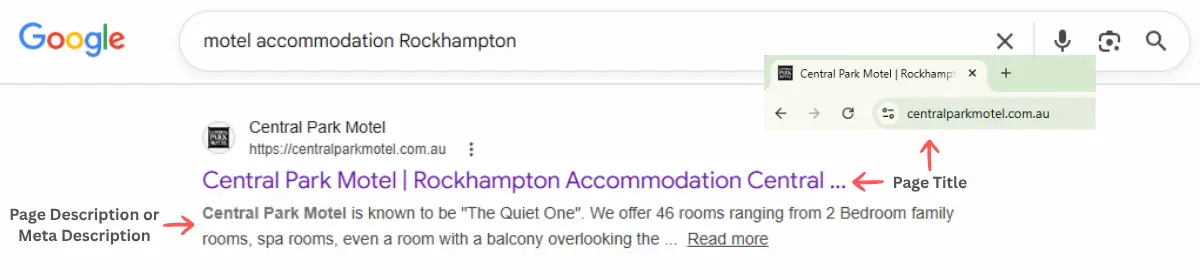
Use your free keyword report to build pages specific to what each guest is searching for. According to the 2026 WhiteSpark Local Ranking Report, having a dedicated page for each service is the highest ranking factor. For example, if a guest is searching for Family Friendly Accommodation or Pet Friendly Accommodation, you would set up your page as follows:
- URL:
yourmotel.com.au/family-friendly-accommodation - SEO Title: Family Friendly Motel Accommodation (Your Location) — aim for 50–60 characters.
- SEO Description (Meta Description): 150 characters. A short, succinct summary of the page with a call to action.
- Page Title: Similar to the SEO Title — Family Motel Room, Location. Around 50–60 characters for readability, but no strict limit.
- H1 Tag: This is the Header on your page and should be a Header 1 or H1. There should only be one of these on the page. H1 should not be a duplicate of the SEO Title — but similar is fine.
- The first paragraph should talk through Family Friendly Accommodation.
If you were doing this for a hotel, you would swap out Motel for Hotel in all of the key places. Google will however understand the meaning if you have motel instead of hotel, but we alway recommend to be explicit in your meaning.
Tip 1
Words at the front of your SEO Title have more ranking effect than those at the back. Learn more about page titles on Screaming Frog.
Tip 2
If your motel is not showing up first when someone searches for your motel's name, check whether multiple pages are ranking. Consider removing your motel name from every page title except your homepage. You want your homepage to rank for your branded search — having multiple pages rank in positions 6, 8, and 9 is far less valuable than your homepage ranking 1st.
Review Velocity: The Active Ranking Signal
Review velocity is the rate at which your property generates new reviews. Google’s algorithm weights recent reviews more heavily than historical ones. We are seeing a really big increase in importance for new reviews. A property with 12 reviews in the last 90 days will often outrank a property with 200 reviews and nothing new in six months.
Tactics to increase review velocity:
- Ask at checkout — a direct verbal request from front desk staff is the highest-converting method.
- Place a QR code linking to your Google review page at reception.
- Add a review request to your post-stay confirmation email.
- Respond to every review within 24 hours — responses signal active management to Google’s algorithm.
- Recent reviews are so important now that we recommend incentivising your on-site motel managers for every review they can get (legitimately, of course). This might be a $10 incentive if they are mentioned in a Google Review, or an extra hour off at the end of the month for each review.
Review velocity is also the fastest way to close the gap on a competitor who has been accumulating reviews for years. See the full channel-by-channel breakdown in the 2026 Motel Marketing Checklist.
Google Business Profile Optimisation Checklist
- Set primary category to “Motel” (not “Hotel” or “Accommodation”). In some locations you will need to set it as “Hotel” if “Motel” is not available.
- If you can put an important search term into the title, this will help your visibility considerably — but make sure you follow Google’s policy. Google requires your Business Name to match either your official company name or the name on your signage. Often, signage has an extra word like accommodation that is genuinely valuable to add to your business name.
- Complete every attribute: parking, air conditioning, pool, accessibility, Wi-Fi.
- Upload 20–30 high-quality photos, updated monthly.
- Write a 750-character description using location keywords (“motel in [town]”, “accommodation near [highway/landmark]”). You can use a free tool like Google Keyword Planner to get search terms and search volume for your location.
- Enable messaging and respond within 1 hour.
- Publish one Google Post per week (local events, property updates, seasonal rates).
- Add your correct website URL and confirm it resolves without redirect chains.
Tip
The accuracy of your listing not only helps guests book your accommodation — it also reduces complaints. In 2026, consistent data is even more important. Google's AI Overview pulls accommodation information from Google Business Profile, your website, OTAs, and many other sources. Having consistent information is an essential part of being visible in the AI Overview.
Pillar 2: Technical SEO
Technical SEO removes the friction between your content and Google’s ability to crawl, understand, and rank it. For motels, two technical priorities outweigh everything else: structured data (Schema markup) and mobile page speed.
JSON-LD Room Schema: Speaking Google’s Language
Schema markup is machine-readable code embedded in your page’s <head> that tells search engines exactly what your content means. For motels, we like the Aggregate Rating, Lodging Business, and Star Rating schemas.
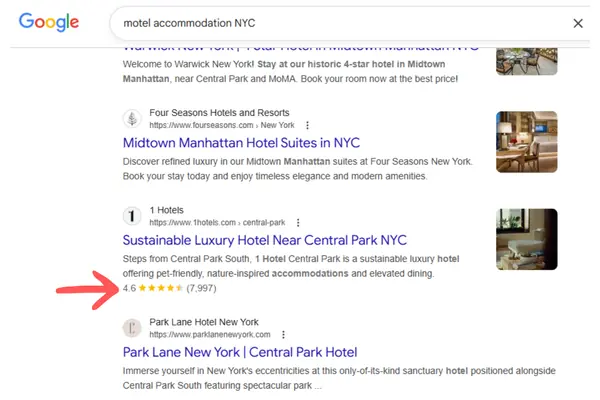
Google has officially announced that Schema is not a direct ranking factor — but there is still real upside for certain types like Aggregate Rating, where Google will often show your review stars next to your property in search results, which increases your visibility and click-through rate (CTR).
{
  "@context": "https://schema.org",
  "@type": "LodgingBusiness",
  "name": "Your Motel Name",
  "url": "https://yourmoteldomain.com.au",
  "telephone": "+61400000000",
  "address": {
    "@type": "PostalAddress",
    "streetAddress": "123 Highway Road",
    "addressLocality": "Your Town",
    "addressRegion": "QLD",
    "postalCode": "4000",
    "addressCountry": "AU"
  },
  "geo": {
    "@type": "GeoCoordinates",
    "latitude": -27.4698,
    "longitude": 153.0251
  },
  "starRating": {
    "@type": "Rating",
    "ratingValue": "3"
  },
  "amenityFeature": [
    { "@type": "LocationFeatureSpecification", "name": "Free Parking", "value": true },
    { "@type": "LocationFeatureSpecification", "name": "Free Wi-Fi", "value": true },
    { "@type": "LocationFeatureSpecification", "name": "Swimming Pool", "value": true },
    { "@type": "LocationFeatureSpecification", "name": "Air Conditioning", "value": true }
  ],
  "priceRange": "$$",
  "containsPlace": [
    {
      "@type": "HotelRoom",
      "name": "Deluxe Queen Room",
      "description": "Queen bed, en-suite bathroom, 50Mbps Wi-Fi, air conditioning, flat-screen TV.",
      "bed": {
        "@type": "BedDetails",
        "typeOfBed": "Queen size bed",
        "numberOfBeds": 1
      }
    },
    {
      "@type": "HotelRoom",
      "name": "Twin Room",
      "description": "Two single beds, en-suite bathroom, air conditioning, ideal for shared or business travel.",
      "bed": {
        "@type": "BedDetails",
        "typeOfBed": "Single bed",
        "numberOfBeds": 2
      }
    }
  ]
}
Implementation notes:
- Embed this in a
<script type="application/ld+json">block in your page<head>. - You can ask ChatGPT, Gemini or a Schema tool to write the Schema for your motel and tell it where to add it on your website, it will help you implement it correctly.
- Once added, validate it with Google’s Rich Results Test.
Hotel and Motel Website Speed: The Road-Tripper Benchmark
The majority of motel searches occur on mobile, often on a patchy regional 4G connection. Google uses Core Web Vitals — specifically Largest Contentful Paint (LCP) and Interaction to Next Paint (INP) — as ranking signals. A page that loads in 4 seconds on mobile is losing both rankings and direct bookings simultaneously.
The 2-second benchmark: Any page that takes longer than 2 seconds to load on a 4G mobile connection is underperforming. Test at PageSpeed Insights and target an LCP under 2.5 seconds.
High-impact speed improvements for motel websites:
- Compress all images to WebP format (the single largest speed win for photo-heavy motel sites).
- Use a CDN for image delivery.
- Remove unused third-party scripts (booking widget bloat, legacy tracking pixels).
- Preconnect to critical third-party origins (fonts, booking engines).
- Avoid render-blocking JavaScript in the page head.
Crawl Budget and URL Hygiene
Independent motel websites are often small (5 to 30 pages), so crawl budget is rarely a problem — unless you have redirect chains, duplicate content on OTA-scraped pages, or parameterised URLs without canonical tags. URL parameterisation is where you have filtering like ?category=queen-room or ?sort=price-low appended to your URL.
Active Parameters
These parameters change what is shown on each of your motel website pages:
- Sorting —
?sort=price-low - Filtering —
?category=queen-room - Pagination —
?page=6 - Searching —
?q=motel-room - Language —
?lang=eng
Passive Parameters
These parameters don’t affect the content on your website but help marketers monitor performance. Looking at a tracking tag, utm_source=facebook indicates that traffic is coming from Facebook, and the medium = social tells you it’s a social channel:
- Tracking tags —
?utm_source=facebook&utm_medium=social - Session IDs —
?sessionid=424124444 - Affiliate IDs —
?ref=travelagentname
Info
UTM is short for Urchin Tracking Module. A helpful explanation of UTM parameters on Reddit for someone new to marketing.
Priority URL hygiene tasks:
- Ensure every page has a canonical tag pointing to its own clean URL. For example, on your motel’s rooms page, you would have this HTML in the page head that points to itself as the master page:
<link rel="canonical" href="https://www.yourmotel.com.au/rooms/">

This achieves three things:

1. **Consolidates your ranking** for variant pages. It passes the authority (or page rank) to your chosen master copy.
2. **Blocks URL parameter duplication.** If you also have yourmotel.com.au/rooms/?category=queen, the canonical tag tells Google not to index the messy URL — just the master URL you've chosen.
3. **Fixes the trailing slash issue.** It tells Google whether you use / at the end of your URL. In the example above, /rooms/?category=queen includes a trailing slash before the parameter.

- [ ] Resolve all redirect chains to single 301 hops.
- [ ] Add noindex to any OTA feed pages, staging URLs, or utility pages.
- [ ] Verify your sitemap.xml contains only indexable, canonical URLs.
Pillar 3: Generative Engine Optimisation (GEO)
In 2026, a growing percentage of travel queries are answered by AI search engines — Google’s AI Overviews, ChatGPT’s browsing mode, and Perplexity — before a user reaches your website. These tools do not rank pages; they synthesise answers from the most clearly structured, factually dense content they can find.
Keep It Simple When It Comes to Getting Cited in AI Overview
- Grab the keyword list we’ve provided.
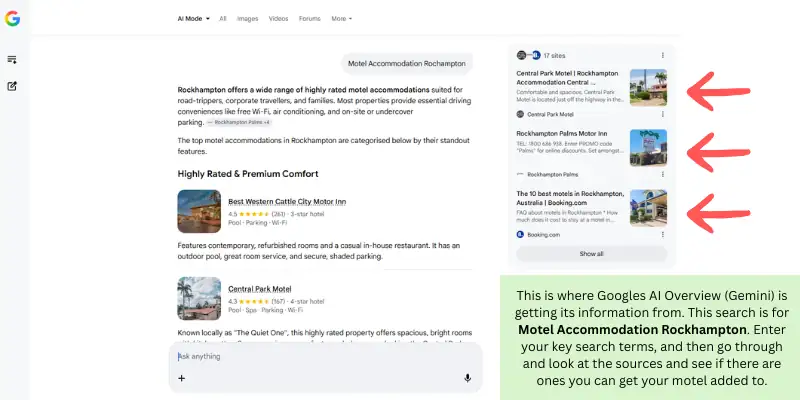
- Go to Google’s AI Overview.
- Enter one of the search terms — on the right of the screen you will see Sources with a list of places AI Overview has pulled its information from.
- Find the places your motel is not listed on, and try to get a listing on them if it makes sense.
How AI Engines Select Source Content
AI search engines prioritise content that:
- Answers a specific question directly — not with preamble, but with the answer in the first sentence.
- Uses structured formatting — numbered lists, definition-style paragraphs, and tables are extracted cleanly.
- Contains verifiable, specific facts — room dimensions, amenity lists, parking specifications, Wi-Fi speeds.
- Maintains consistent entity data — your property name, address, and attributes appear identically across your website, GBP, and OTA profiles.
The underlying principle is information density. “Beautiful rooms with stunning views” tells an AI engine nothing useful. “King bed, 52-inch TV, blackout curtains, en-suite with rainfall shower, 100Mbps fibre Wi-Fi, B-Double truck parking” gives it everything it needs to recommend your property for a specific query.
Structured Content Patterns for AI Visibility
Pattern 1: Direct answer formatting
Write a dedicated section for every query your guests ask:
Does [Motel Name] have truck parking? Yes. [Motel Name] provides B-Double and semi-trailer parking in a sealed rear lot with 24-hour access. No booking required.
This format — question as heading, answer as the immediate first sentence — is the exact structure AI engines extract for featured responses.
Pattern 2: Amenity fact blocks
Replace marketing language with data:
| Feature | Specification |
|---|---|
| Wi-Fi | 100Mbps fibre, unlimited data |
| Parking | B-Double capable, free, sealed |
| Check-in | From 2:00pm, after-hours self-check available |
| Check-out | 10:00am standard, 11:00am on request |
| Pet policy | Not accepted |
| Accessible rooms | 2 rooms, ground floor, roll-in shower |
Pattern 3: Location context paragraphs
AI engines weigh location-specific content heavily for accommodation queries. Write one paragraph per key demand source:
[Motel Name] is located 2km from [Hospital Name], making it the closest accommodation option for visiting families and long-stay healthcare workers. Ground-floor rooms with private entry are available for extended stays. Direct booking rates for stays of 7+ nights are available by phone.
Repeat this pattern for every major local employer, hospital, event venue, or highway interchange within your demand catchment.
GEO Content Audit
- Every room type has a dedicated page or section with factual specifications.
- A “Frequently Asked Questions” section answers the 10 most common guest queries.
- Location context paragraphs cover each major local demand source.
- Amenity lists use specific data, not marketing language.
- Property name, address, and phone are consistent across all indexed pages.
Motel Coach SEO Serivices
Our company tailors the seo services to your requirements. We a specialist in the accommodation space catering to hotels, motels, hostels and inns.
- Citation building for hotels
- GBP (Google Business Profile) optimisation
- NAP Cleanup Service
- On-page hotel website SEO optimisation
- Off-site SEO optimisation
- Local authority building
- Hotel website indexation
The Direct Booking Bridge
Search visibility means nothing if the traffic it generates does not convert. The final step in the Motel SEO framework is ensuring that every visitor who arrives from Google — whether through organic results, the Map Pack, or an AI summary — lands on a page built to capture a direct booking.
This means:
- A fast, mobile-optimised property website that loads before the visitor loses patience on a regional connection — see our Motel Website Design guide for the specific on-page SEO, design, and trust signals we like to employ.
- Rate parity with OTAs displayed clearly, with a “Book Direct & Save” message that gives guests a reason to bypass Booking.com.
- A friction-free booking engine with no hidden fees, no mandatory account creation, and a mobile-optimised checkout flow.
- Trust signals above the fold — Google review score, TripAdvisor rating, number of reviews — so the guest who found you via SEO has immediate confidence.
The compound effect of getting your motel SEO right is considerable, and you will start to see big increases in profitability, reach out to Motelcoach for the best hotel seo services. There is a lot to learn, some elements will take time to produce results, and there are risks involved if you get it wrong. Start with a small element, do a deep dive into that content, and build from there step by step. If you want to work with us, it is best to start with our Free Website and SEO Audit.
Motelcoach is a specialist SEO agency for hotels, motels and accommodation providers in Australia. Our Company provides SEO Services for regional hubs like Rockhampton, Townsville, Lismore and Mackay across New South Wales, Queensland, Victoria, Tasmania, Western Australia, Australian Capital Territory, and the Northern Territory.