
Fri Feb 13 2026
Motel Inventory Management: The 2026 Revenue & Yield Guide
Executive Summary: Key Takeaways
Maximise your total yield by preventing "early sell-outs" that block high-value, multi-night bookings. Effective inventory control requires a shift from filling beds to protecting your booking window through Minimum Length of Stay (MLOS) restrictions, Closed to Arrival (CTA) fences, and tiered rate reviews. By identifying demand spikes 30 to 90 days out, you use peak demand to fill quiet shoulder dates. To audit your current distribution strategy and automate these controls, engage our Motel Consultancy or enrol in our motel management training courses.
Last Updated: 18/02/2026
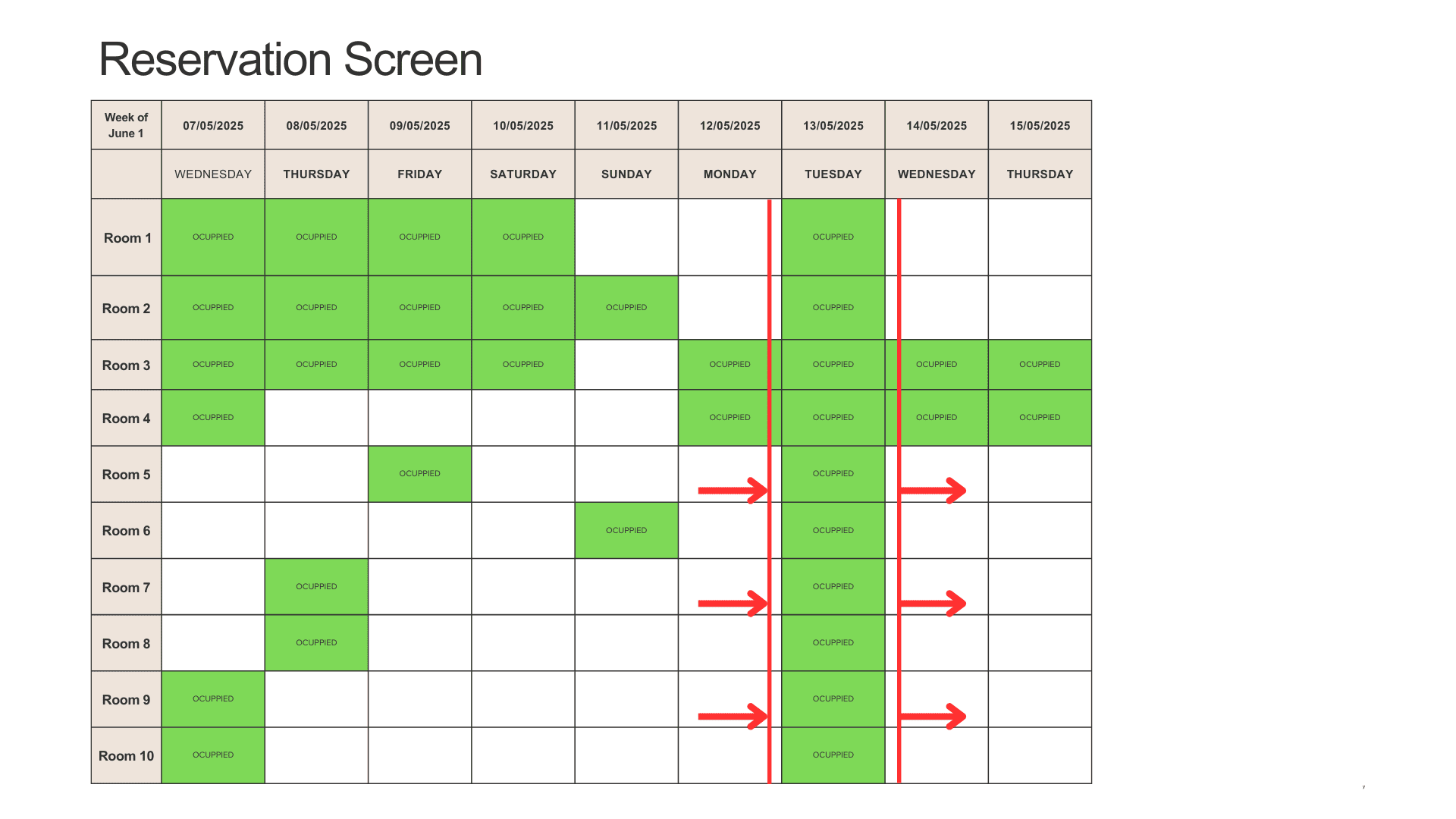
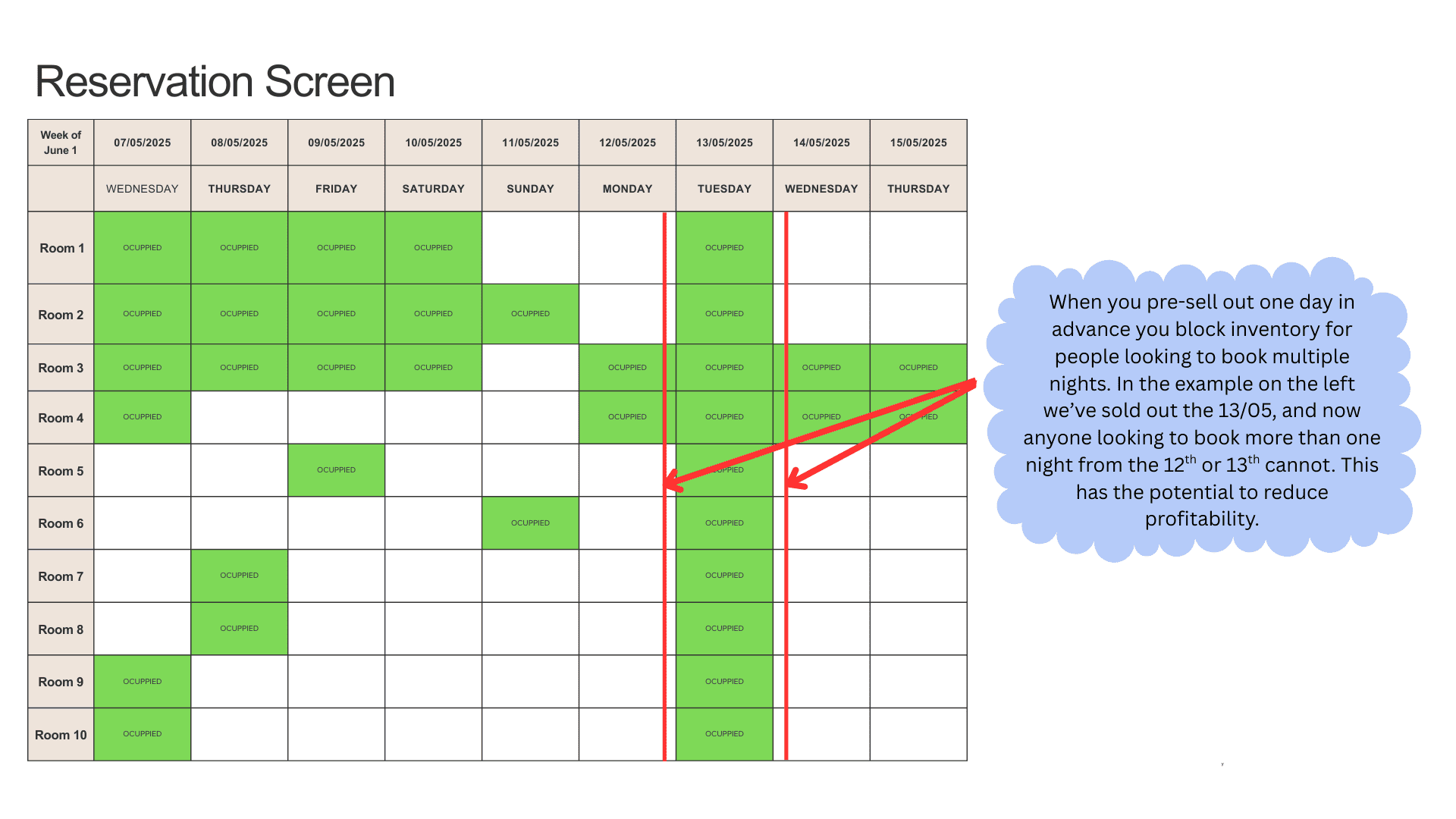
Managing available room inventory is the difference between surviving and thriving. If you are sitting at 100% occupancy a month out, you have likely failed. A “Sold Out” sign appearing too early indicates your rates are too low and your strategy is too soft. You have allowed single-night travelers to steal inventory from high-yield, multi-night guests.
Effective motel management requires filling rooms with the right guest, at the best price, through the optimal channel.
1. The “Early Sell-Out” Trap & Booking Windows
Stop looking at yesterday’s numbers. Run strict reviews of your upcoming 30, 90, and 365-day booking windows.
- The Logic: Long-stay guests book early. Single-night “road warriors” book late.
- The Error: Selling your last room to a single-night guest 60 days out rejects every 3-night or 5-night inquiry that would have covered your quiet “shoulder” days.
- The Fix: Use booking windows to spot demand spikes. If a spike occurs, stop selling standard rates immediately. Raise the rate or restrict one-night stays.
Tracking Your Booking Window
To leverage revenue strategies, you must understand your property’s specific booking velocity:
- Stage 1: Track your booking window for all room types based on the month.
- Stage 2: Split your tracking into two segments: Standard/Twin Rooms vs. Family/Multi-person suites.
- Stage 3: Overlay school holiday and regional event periods to predict demand shifts.
(For 100s of operational templates, refer to The Essential Guide to Motel Management).
2. Balancing Occupancy vs. Average Daily Rate (ADR)
The goal is to maximize RevPAR (Revenue Per Available Room), not just achieve 100% occupancy.
- The Math: High occupancy with heavy discounts often yields less profit than 80% occupancy at premium rates. A higher ADR offsets lost room nights and reduces variable costs (housekeeping, linen, amenities).
- Yielding Rates: Increase your room rates as occupancy rises. The closer you get to a sell-out, the higher your rates must be for remaining rooms. Early bookers secure lower rates; last-minute guests pay a premium.
- The Red Flag: If your motel hits 100% occupancy frequently while local competitors still have availability, your prices are structurally below market value.
3. Core Inventory Controls & Rate Fencing
Use strict inventory controls to force the market to behave according to your revenue goals.
Minimum Length of Stay (MLOS)
During events or peak weekends, enforce an MLOS to maximize revenue.
- Execution: If a popular two-night festival occurs, require a 2-night minimum stay. This prevents a one-night booking from blocking a room that could be sold for the entire weekend.
- Tiering: Apply a 3-night minimum on standard rooms and a 2-night minimum on premium suites. Force short-stay guests into higher-paying brackets.
Closed to Arrival (CTA)
Set high-demand dates as “closed to arrival,” meaning guests cannot check in on that specific day (though they can stay through it).
- Execution: If Saturday is the peak event night, closing Saturday to arrivals forces guests to book Friday-Saturday or Saturday-Sunday, capturing shoulder night revenue.
Rate Fences
Attach conditions to discounted rates so they do not cannibalize your primary revenue.
- Advance Purchase: Offer lower rates for bookings made 21+ days in advance with a strict non-refundable policy.
- Channel Fencing: Offer value-adds (e.g., free breakfast or late checkout) exclusively to guests booking via your direct website to reduce OTA commission reliance.
4. Advanced Tactics: Stop-Sell and Overbooking
The Stop-Sell Strategy
Halt sales of specific rooms or rates on third-party channels to control distribution.
- Close Cheap Rates: When occupancy reaches 80%, stop-sell your lowest rate plans. Force remaining demand into premium room categories.
- OTA Shut-Off: When down to your last two rooms, apply a stop-sell on high-commission OTAs. Ensure final inventory is sold via direct, commission-free channels.
Controlled Overbooking
Compensate for historical “wash” (cancellations and no-shows) to ensure a 100% realized fill rate.
- Calculate the Wash: Analyze historical data to find average last-minute cancellations.
- Set the Buffer: Cap overbooking at a strict limit (e.g., 2-3 rooms for a 50-room property).
- The Walk Plan: You must have a pre-arranged agreement with a nearby competitor to “walk” displaced guests if no-shows do not materialize. Overbooking without a walk plan is an operational disaster.
5. Leverage Your PMS and Channel Manager
Manual inventory management causes double-bookings and revenue leaks. Your tech stack must automate these rules.
- Pooled Inventory: Ensure your Channel Manager uses pooled inventory to sell all rooms across all channels simultaneously, updating globally the second a booking occurs.
- Automated Rules: Program your MLOS and CTA restrictions into your PMS months in advance based on your demand forecast. Do not rely on manual daily adjustments.
Missing small rate increases and restrictions equates to $100,000+ in revenue leaks for a standard 20-room property. To deploy these advanced revenue strategies, engage our Motel Consultancy Services or master the technical execution through our Motel Management Training Course.